Updated July 2026 ~8 min read By the SaluVista Medical Team
Medically reviewed by Dr. Elif Şahin
Quick answer
Professional teeth whitening in Turkey uses a dentist-supervised bleaching gel to lighten natural enamel, either in-chair in about an hour or with custom take-home trays over one to two weeks. It is safe when a dentist assesses you first, gives realistic rather than dramatic results, and is not permanent — expect roughly one to three years before a top-up.
Two main options: faster in-chair whitening and gentler, dentist-prescribed take-home trays, often combined.
Whitening only lightens natural teeth — it does nothing to crowns, veneers or fillings.
It is not permanent: results typically last 1–3 years depending on diet, smoking and care.
Whitening first, veneers only if needed: a conservative dentist protects healthy enamel and avoids irreversible work you don't need.
Teeth whitening is the most popular, and the least invasive, cosmetic dental treatment there is. If your teeth are healthy but have yellowed or dulled with age, coffee or tobacco, professional whitening can lift the shade without touching the tooth structure at all. This guide explains the real options available in Turkey, what is safe, what results are honestly achievable, and the important cases where whitening isn't the right tool, so you can talk it through properly with a dentist. It's general information to help you prepare, not medical advice.
Your whitening options
"Professional whitening" means a treatment carried out or prescribed by a qualified dentist using a controlled concentration of bleaching gel — quite different from supermarket strips or charcoal pastes. There are two main clinically established routes, and they're often used together.
In-chair (in-office) whitening
The dentist protects your gums, applies a professional-strength gel to the teeth and, in some systems, activates it with a light. It takes roughly 45–90 minutes in a single visit and gives the fastest visible jump in shade. It's a good fit when you want a noticeable result quickly. It can, for example, be timed around a short stay in Istanbul.
Take-home trays
The dentist takes impressions and makes custom-fit trays, then prescribes a lower-concentration gel you wear at home for a set time each day over one to two weeks. It's gentler, tends to cause less sensitivity, and lets you top up in future. Many people get the best of both by starting in-chair and maintaining with trays.
Not the same as a shop-bought kit. Over-the-counter strips and DIY "hacks" use weaker or unregulated ingredients and no assessment of your teeth and gums. The ADA's MouthHealthy advises talking to a dentist before whitening so the method suits your mouth.
In-chair vs take-home at a glance
General comparison — your dentist personalises this after assessment.
In-chair whitening
Take-home trays
Where
In the dental chair
At home, dentist-prescribed
Time to result
One visit (~45–90 min)
~1–2 weeks of daily wear
Gel strength
Higher, professionally applied
Lower, custom trays
Sensitivity
Can be more noticeable, usually brief
Often gentler
Best for
A fast lift on a short trip
Gradual change & easy top-ups
Maintenance
Top up later with trays
Reuse trays with fresh gel
Is teeth whitening safe?
Professional whitening prescribed by a dentist has a long record of safe use. The most common side effects are temporary tooth sensitivity and mild gum irritation, which typically settle within a few days. The safeguards that matter are simple: a proper check of your teeth and gums first, correct gel concentration, and protection of the soft tissues during treatment.
That assessment isn't a formality. Whitening isn't advised over untreated decay, active gum disease, exposed roots or during pregnancy, and results are unpredictable on certain kinds of internal staining. This is why, at SaluVista, whitening is only carried out after a dentist has examined you and a qualified dentist makes the final decision, never on demand. Good general mouth care, as the NHS guide to healthy teeth and gums describes, also underpins any good cosmetic result.
The safest whitening starts with a "no" where it's warranted. That means a dentist treats decay or gum disease first, rather than bleaching over a problem.
Realistic results & how long they last
Whitening can make a real, visible difference. But it's a brightening of your own teeth, not a switch to an artificial "Hollywood white". How much your shade lifts depends on the type and depth of staining you start with. Surface stains from food, drink and tobacco respond well; some age-related and internal discolouration responds less. A dentist will give you an honest idea of the likely result before you commit.
How long it lasts
No whitening is permanent. Most people enjoy a noticeably brighter shade for around one to three years before it gradually fades, as coffee, tea, red wine and smoking reintroduce staining. Simple habits (reducing staining drinks, not smoking, good daily brushing) stretch results out, and an occasional take-home top-up refreshes them without starting over.
Whitening only works on natural enamel. Crowns, veneers, bonding and tooth-coloured fillings don't change colour. If your front teeth already carry restorations, whitening the teeth around them can leave shades mismatched, a reason to plan the sequence with your dentist.
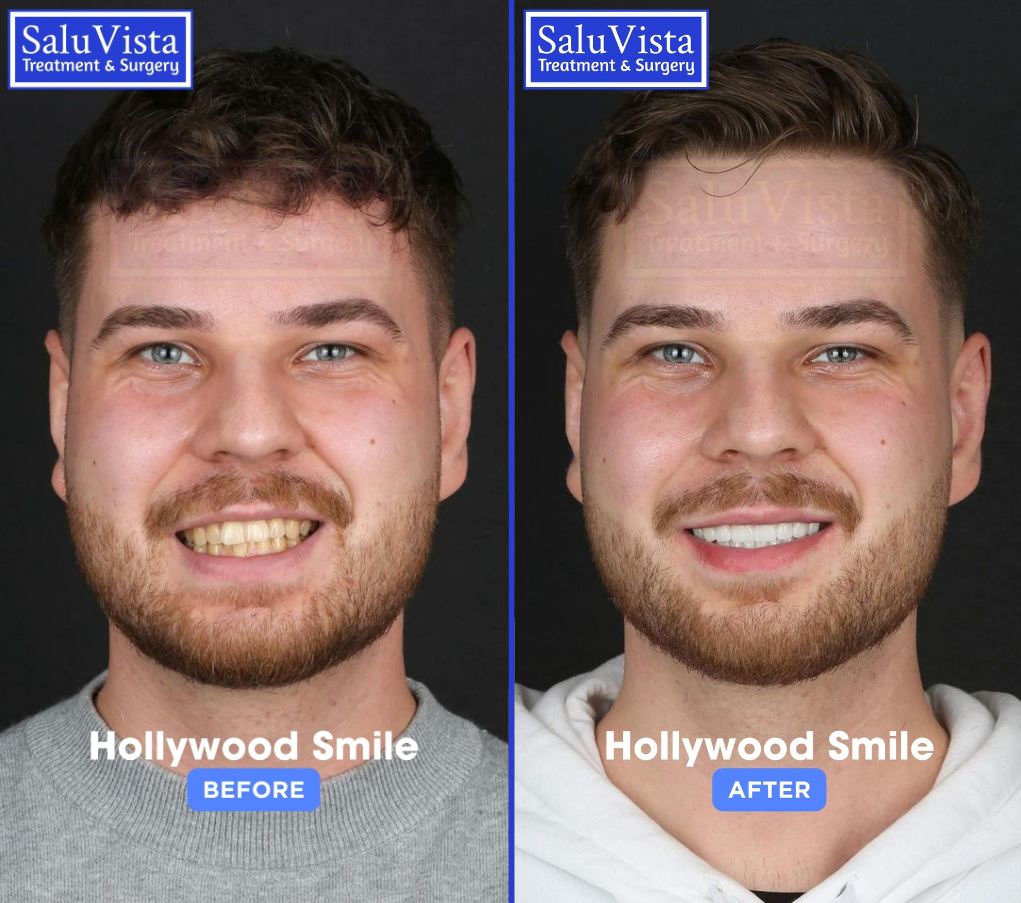
A real SaluVista hollywood smile result, shared with documented consent. Individual results vary from person to person, and no procedure can guarantee a specific outcome.
When whitening is not the answer
A good, conservative dentist is as clear about whitening's limits as its uses. Whitening changes colour only. It doesn't touch the shape, size, position or health of a tooth. It won't help if your concern is:
Chips, cracks or worn edges — that's a job for bonding or veneers, not bleaching.
Gaps, crowding or crookedness — alignment (or, cosmetically, veneers) is the route, often via a full smile makeover.
Existing crowns or veneers on the front teeth — the gel won't lighten them.
Deep internal staining or a single dark tooth — these may need different, targeted treatment.
In these situations, whitening alone will disappoint. The honest answer is a different plan, and sometimes the honest answer is that your natural shade is already healthy and no treatment is needed at all.
Whitening or veneers — how to think about it
This is the decision most people are really asking about, so it's worth being direct. Whitening is reversible in spirit and touches nothing. It simply lifts the shade of healthy teeth. Veneers are irreversible: thin shells are bonded to the teeth, which usually involves removing a little enamel, and that enamel doesn't grow back. Veneers can transform shape, alignment and colour together; whitening can only change colour.
Because protecting healthy tooth structure matters, the conservative sequence is to whiten first where whitening can achieve the goal, and reserve veneers for cases where colour alone won't get you there: worn, chipped, gapped or uneven teeth. Our cosmetic lead Dr. Zeynep Y. (prosthodontics: veneers, crowns and smile design) approaches every consultation this way; you can read more about the team on our dentists page. If veneers do turn out to be the better fit, our guides to veneers cost in Turkey and the Hollywood smile explain what's involved and the choices along the way.
Whitening vs veneers — a starting-point comparison, personalised at consultation.
Whitening
Veneers
Changes
Colour only
Colour, shape, size, alignment
Invasiveness
None — no enamel removed
Irreversible — some enamel usually removed
Best for
Healthy, aligned but stained teeth
Chips, gaps, wear, uneven shape
Longevity
~1–3 years, then top up
Long-lasting, but not "forever"
Reversible
Effectively yes
No
Cost & what a quote includes
Professional whitening is usually the most affordable cosmetic dental treatment, priced as a single course rather than per tooth, which is why it's often the sensible first step before considering anything bigger. For comparison, cosmetic alternatives at SaluVista are itemised per tooth: veneers from £320 / $430 per tooth, zirconium crowns from £190 / $255 per tooth, dental implants from £230 / $310 each, and a full Hollywood smile from £5,000 / $6,730 depending on the plan (£1 ≈ €1.18, so roughly €5,900 for a Hollywood smile).
However you're treated, your price is a transparent, itemised quote confirmed after assessment. It's never an off-the-shelf figure. Beware any offer that quotes whitening (or veneers) before a dentist has seen your teeth. For the wider picture on dental pricing and planning, start at our dental hub.
Wondering if whitening — or something else — is right for your smile?
Send a photo and tell us what you'd like to change. A SaluVista dentist gives you an honest recommendation. That might mean whitening, an alternative, or reassurance that you don't need treatment.
Because in-chair whitening is quick, it fits comfortably into a short visit and is often combined with a check-up or hygiene clean. The SaluVista process is designed so nothing is decided in a rush: you speak with your dentist before you travel, screening and booking happen in the app, and a qualified dentist confirms whitening is appropriate for you before any treatment starts. If your goal turns out to need a different approach, you'll know that in advance. Not in the chair.
Frequently asked questions
How much does teeth whitening cost in Turkey?
Professional whitening in Turkey is typically far less than cosmetic alternatives like veneers, which at SaluVista start from £320 / $430 per tooth. Whitening is priced as a single course rather than per tooth, and you receive a transparent, itemised quote confirmed only after a dentist has assessed your teeth and gums. Cost should never be the deciding factor over suitability.
Is professional teeth whitening safe?
When carried out or prescribed by a qualified dentist after checking your teeth and gums, professional whitening has a long record of safe use. The most common side effects are temporary tooth sensitivity and mild gum irritation, which usually settle within a few days. It is not suitable for everyone, which is why an assessment comes first and a qualified dentist makes the final decision.
How long do the results of teeth whitening last?
Whitening is not permanent. Most people keep a noticeably brighter shade for roughly one to three years, though this varies with diet, smoking and oral hygiene. Coffee, tea, red wine and tobacco gradually reintroduce staining. Occasional top-up treatments and good daily care help results last longer, but no whitening treatment lasts forever without maintenance.
Does teeth whitening work on crowns, veneers or fillings?
No. Whitening gels only lighten natural tooth enamel. Crowns, veneers, bonding and tooth-coloured fillings don't change colour, so whitening natural teeth around existing dental work can leave the shades mismatched. If your front teeth already have restorations, a dentist may recommend a different plan such as veneers or a smile makeover instead.
Should I choose whitening or veneers?
Whitening is the least invasive option and is ideal when your teeth are healthy and well-aligned but simply stained or yellowed. Veneers are a bigger, irreversible step that can also change tooth shape, size and alignment. A conservative dentist recommends whitening first where it can achieve your goal, and only suggests veneers when whitening alone cannot deliver the change you want.
Can I whiten my teeth as part of a trip to Turkey?
Yes. Professional whitening is quick, so it fits within a short visit and is often combined with a check-up. With SaluVista you speak with your dentist before travelling, screening and booking happen in the app, and a qualified dentist confirms whitening is right for you first. Get the SaluVista app or message us to start.
This article is general information, not medical advice, and does not replace a consultation with a qualified dentist. Individual results and recommendations vary. Always discuss your options and risks with a dental professional.
Send a message and a SaluVista coordinator gets back to you in your language — we support 11+ languages including English, Arabic, Russian and German. For a private medical screening, we'll guide you into the app.
Thank you! Your message is on its way — a SaluVista coordinator will reply soon.
Something went wrong. Please try again, or message us directly on WhatsApp.