Do veneers damage your teeth? An honest answer
Quick answer
Traditional veneers do involve removing a thin layer of enamel, often around half a millimetre, so the veneer sits naturally on the tooth. That enamel does not grow back, so the tooth will always need a covering afterwards. Done conservatively and for a genuine reason, this is a controlled, well-established change rather than "ruining" a healthy tooth. But it is irreversible.
- Traditional veneers remove some enamel (commonly ~0.3–0.7 mm), a permanent change to the tooth.
- No-prep and minimal-prep veneers keep most or all enamel and are far more conservative, but only suit some cases.
- Alternatives — whitening, composite bonding, aligners — can solve many concerns without enamel removal.
- A good dentist protects healthy tooth structure and offers the least invasive option that actually fixes the problem.
In this guide
"Do veneers damage your teeth?" is one of the most sensible questions you can ask before smile work. It deserves a straight answer rather than a sales pitch. The short version: traditional veneers usually require removing a little enamel, and enamel doesn't regenerate, so that is a permanent change. Whether that counts as "damage" depends on how much is removed, why, and whether a gentler option would have done the job. This guide explains it honestly so you can decide with confidence.
It's general information to help you prepare, not medical advice.
The honest truth about enamel
Enamel is the hard outer shell of your tooth. It's remarkably tough. But it has one important limitation: it does not grow back. Once a layer is removed or worn away, the body cannot replace it. That's the single most important fact behind this whole question.
A traditional porcelain veneer is a thin shell bonded to the front of a tooth. For it to sit flush and look natural, rather than bulky or "stuck on", the dentist usually shapes away a very thin layer of enamel first. That enamel is gone for good. The tooth will always need to be covered from then on, whether by that veneer or a future replacement, which is why a careful dentist treats veneer prep as a genuine, considered decision, not a casual cosmetic tweak.
Removing enamel is not automatically "damage". But it is irreversible, and that deserves a real conversation before you commit.
The good news: looking after your enamel and gums day to day is squarely within your control. The UK's NHS guidance on healthy teeth and gums and the American Dental Association's MouthHealthy both set out the fundamentals that keep both your natural teeth and any dental work healthy for longer.
How much enamel is removed?
For a traditional veneer, the amount is small. Dentists typically shape away a very thin layer, often in the region of 0.3 to 0.7 millimetres across the front and edge of the tooth. To picture that, it's roughly the thickness of a fingernail. The goal is always to remove the least amount needed for a strong bond and a natural, proportionate result.
The exact amount depends on your teeth. Someone with slightly worn or already-restored teeth may need very little preparation; someone wanting a big change in shape or colour may need a fraction more so the porcelain can mask what's underneath. A conservative dentist plans this precisely rather than removing a standard amount for everyone.
Traditional vs no-prep veneers
Not all veneers touch your enamel to the same degree. Understanding the difference is the key to answering the "damage" question for your situation, and our fuller guide to the different types of dental veneers goes deeper, but here's the essential comparison.
| Traditional (prep) veneers | No-prep / minimal-prep veneers | |
|---|---|---|
| Enamel removed | A thin layer (often ~0.3–0.7 mm) | Little or none |
| Reversibility | Permanent — tooth always needs covering | Far more conservative; sometimes reversible |
| Best for | Bigger changes in shape, colour or alignment | Smaller changes; well-aligned, healthy teeth |
| Suitability | Wide range of cases | Only some cases — not everyone qualifies |
| Look & feel | Very natural, sits flush | Natural, but can be slightly fuller |
No-prep and minimal-prep veneers keep most or all of your natural enamel, which makes them the more tooth-preserving choice when they're suitable. They're not a fit for every case. Teeth that are crowded, badly discoloured or need a large change in shape often can't be treated well without some preparation, and anyone who promises a dramatic transformation with "zero" tooth alteration in every case is overselling. If you're also weighing crowns, our veneers vs crowns comparison explains how much more tooth a crown involves.
When veneers are the right call
Veneers can be an excellent, well-justified treatment. The honesty is simply in knowing when. They tend to make sense when:
- You have several concerns at once, such as colour, shape, small gaps or minor chips, that a single, gentler treatment can't fully solve.
- The colour change you want won't respond to whitening (for example, certain deep or internal stains).
- Teeth are already chipped, worn or previously restored, so the enamel picture has changed anyway.
- You want a durable, stain-resistant result and understand it's a long-term commitment.
They're a less obvious choice when a single, simpler treatment would solve your actual concern, for instance whitening alone for colour, or aligners alone for a bit of crookedness. A conservative dentist starts from your specific problem. Veneers come up only if gentler routes fall short. Our page on how long veneers last gives a realistic sense of the commitment.
At SaluVista, prosthodontics and smile design are led by Dr. Zeynep Y. Her approach starts with the least invasive option that genuinely fits your goals. In the UK, you can always check a dentist's registration with the General Dental Council, the profession's statutory regulator.
Gentler alternatives to consider
Enamel doesn't come back. It's worth knowing what can be done without removing any. Depending on your concern, these may achieve what you want more conservatively:
Professional whitening
If your main issue is colour, supervised whitening can lighten teeth without altering their structure at all, though it won't reshape a tooth or close a gap. For staining, it's often the least invasive place to start.
Composite bonding
Tooth-coloured composite can reshape edges, close small gaps and repair minor chips, usually with little or no enamel removal, and it's more repairable than porcelain and often reversible, though it can stain over time and isn't as hard-wearing.
Clear aligners or orthodontics
If teeth are crooked or crowded, moving them into place with aligners treats the cause rather than covering it. It keeps all your enamel too. It takes longer than veneers, but it's a fundamentally tooth-preserving route.
How to protect your teeth (with or without veneers)
Whether you choose veneers or not, the tooth underneath still needs care. Veneers don't make a tooth cavity-proof, and the gum line and back of the tooth remain exposed. To keep both natural teeth and any dental work healthy:
- Brush and clean between teeth daily — decay under or around a veneer is a leading cause of problems.
- Treat gum disease first. Healthy gums are the foundation for any lasting cosmetic work.
- Wear a night guard if you grind. Managing bruxism protects both veneers and natural teeth from excess force.
- Keep regular check-ups. Small issues caught early stay small.
These are the same fundamentals the NHS recommends for everyone. They matter more, not less, once you've invested in your smile.
How we approach it at SaluVista
SaluVista is an Istanbul-based medical-travel platform (an Orozan company). Before you travel, you speak with your dentist about what you actually want to change. Screening and booking happen in the app, and a qualified human makes the final decision on what's appropriate. That means no one talks you into irreversible work sight unseen.
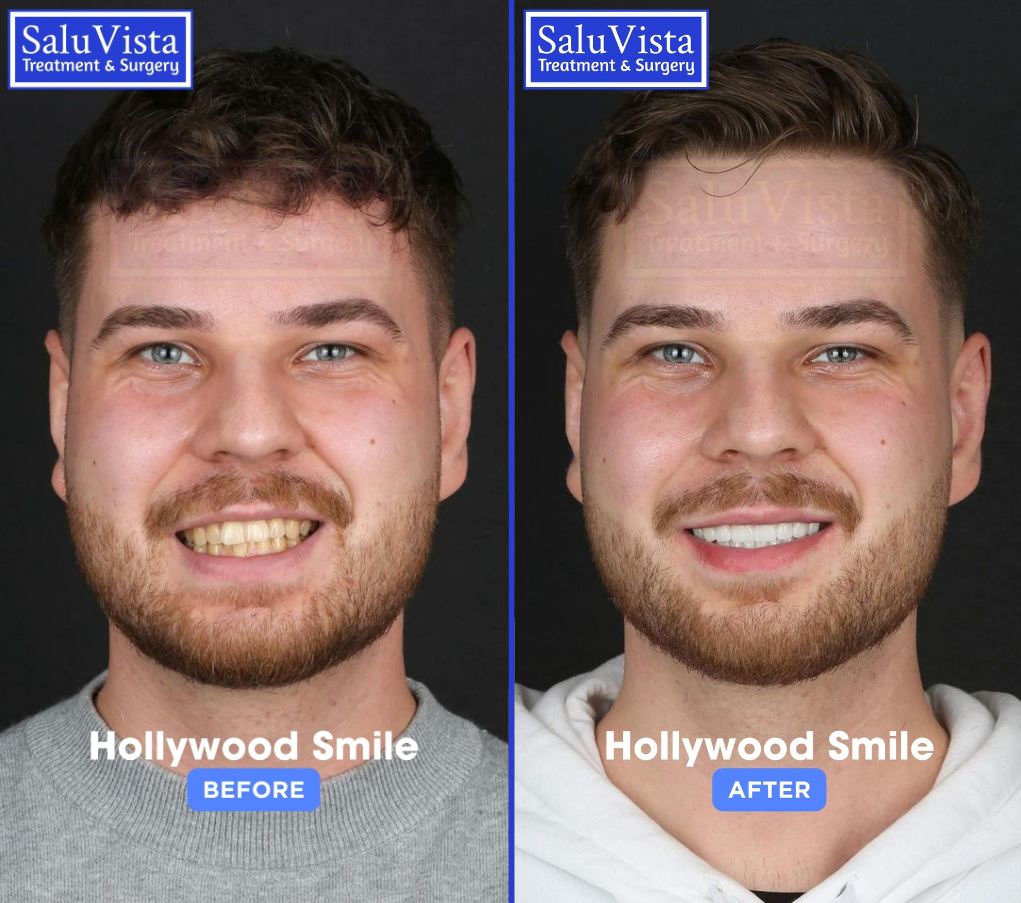
Pricing is always a transparent, itemised quote confirmed after assessment. As a guide, veneers start from £320 / $430 per tooth (about €380), zirconium crowns from £190 / $255 per tooth, and a full Hollywood smile from £5,000 / $6,730 depending on the plan. If a gentler treatment would serve you better, our dentists will say so. Explore the full SaluVista dental hub for how treatment, travel and aftercare fit together.
Wondering if veneers are right for you — or if something gentler would do?
Share a few photos and what you'd like to change, and a SaluVista dentist gives you an honest, personalised view, including the least invasive option, and whether veneers are worth it at all.
Get an honest assessment →